





Characteristics of buildings that impact wellbeing

Contents |
[edit] Introduction
Sustainable buildings provide benefits to the environment, society and economy (also known as planet, people and profit) and create win-win-win situations. In other words, a sustainable building should help to reduce carbon emissions, provide a safe, healthy, comfortable and stimulating environment and help to improve satisfaction and productivity of the users.
Different characteristics of a building, both quantitative and qualitative, have a huge impact on the health and wellbeing of its occupants. The Building Services Research and Intelligence Association (BSRIA) a science-driven, independent organisation providing practical guidance and commercial solutions for the built environment, delivers insights into these and other topics through the use of instrumentation, testing, research, and regular publications.

[edit] Indoor Environmental Quality
BSRIA describes these various characteristics or qualities as being incorporated into a building's Indoor Environmental Quality (IEQ) which is determined by five factors:
- thermal comfort (see also article thermal comfort in buildings)
- indoor air quality (see also article indoor air quality)
- odours (see also article odours in and around buildings)
- sound levels (see also article noise levels and sound v noise)
- light levels (see also article light and lighting articles)
There are quantitative measures which may include:
- Air quality (for pollutants and moisture/odour etc.)
- Air movement
- Ventilation (in terms of fresh air and temperatures)
- Noise levels (external, internal from staff and internal from assets)
- Light and glare
- Temperature and responsiveness of building and controls
- Management of building services (complaints etc.)
And qualitative measures:
- Perceived comfort and health from surveys of occupants
- Inferred information on stress and ease of use of spaces (controls, access etc)
- Sickness records
There are variety of factors that can impact indoor air quality (IAQ) and in turn can impact IEQ, such as VOCs, electromagnetic frequency and other factors which might be considered as impacting the internal space of buildings such as aesthetics, volume, materials, nature, sunlight, views etc. For further information see the articles indoor air quality and indoor environmental quality.
[edit] Wellbeing in Buildings
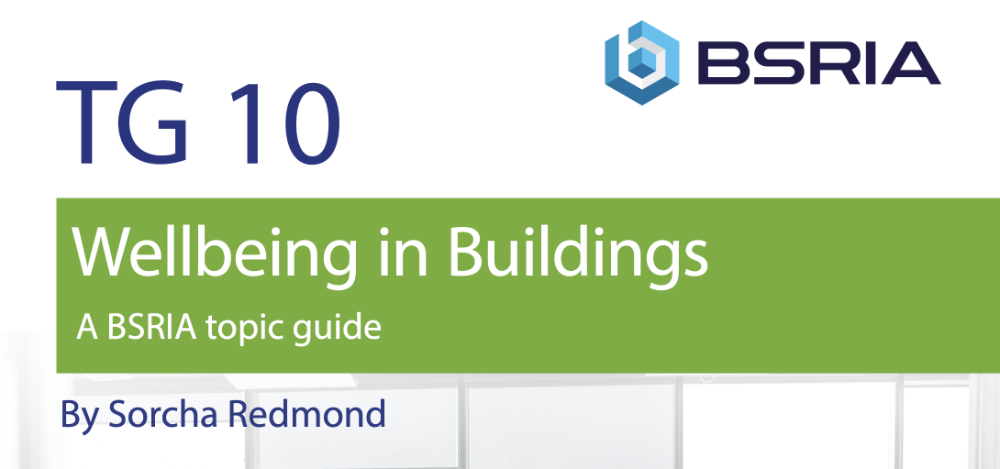
BSRIA, as a specialist in assessing environmental characteristics provides a number of services that can positively change the built environment to improve the wellbeing of occupants. It publishes the topic guide Wellbeing in Buildings (TG 10/2025) which considers what wellbeing means, how it has changed over time and what people need for their wellbeing. Looking at the growing importance of wellbeing in the built environment, including information on building assessment schemes and how the built environment’s influence on wellbeing has positively influenced approaches to health, mental health and overall wellbeing across the industry.
The guide discusses how wellbeing has featured more prominently in building assessment schemes including BREEAM before becoming central to the WELL and Fitwel schemes. The multiple assessment elements for wellbeing in these schemes are outlined, demonstrating their broad and equitable approach to optimising buildings for wellbeing. This has been further highlighted by the most recent update of BREEAM version 7, with further prioritises wellbeing in its assessment (see the article 35 Years of BREEAM and latest V7 mandatory update)
This article appears on the BSRIA website as "Wellbeing" and the topic guide TG10 can be found here.
--BSRIA
[edit] Related articles on Designing Buildings
- 35 Years of BREEAM and latest V7 mandatory update.
- A case study of adopting BIT-Kit: A method uncovering the impact buildings have on people.
- A measure of net well-being that incorporates the effect of housing environmental impacts.
- Airtightness of energy efficient buildings.
- Adapting 1965-1980 semi-detached dwellings in the UK to reduce summer overheating and the effect of the 2010 Building Regulations.
- BSRIA Briefing 2023. Cleaner Air, Better Tomorrow.
- Daylight benefits in healthcare buildings.
- Health and wellbeing impacts of natural and artificial lighting.
- Health and wellbeing at Kings Cross.
- Indoor air quality
- Integrated modelling, simulation and visualisation (MSV) for sustainable built healing environments (BHEs).
- Nuisance in construction.
- Nuisance smells.
- Odours in and around buildings.
- The design of extra care housing for older people and its impact on wellbeing: The East Sussex perspective.
- The daylight factor.
- The impact of the design of the Psychiatric inpatient facility on perceptions of Carer wellbeing.
- The real cost of poor housing.
- Transitioning to eco-cities: Reducing carbon emissions while improving urban welfare.
- The real cost of poor housing.
- Ubiquitous sensors to assess people’s energy consumption and wellbeing in domestic environments.
- Well-being and regeneration: Reflections from Carpenters Estate.
- Wellbeing.
- Wellbeing and buildings.
- Wellbeing in Buildings TG 10/2025.
- Wellbeing and creativity in workplace design - case studies.
Featured articles
Check out some of the best features and news from Designing Buildings as well as key stories from around the web.

Government approach could undermine delivery and regeneration.
World's first mass timber data centre.

The overlooked environmental aspect of data centre development.
Introduction to radon awareness

New technical information sheet published by CIOB.

Updated supplier guide can help electrical contractors engage with NHP.

CIAT confirm the winners of the 2026 architectural technology awards.

Government launches a one stop shop for flood preparedness.

Sir Edwin Lutyens: Britain's greatest architect? Book review.

CIOB publishes free template to help assess and manage risks.
ECA's reflections on Party Conference season

Burnham wants to be confident of winning before asking for a fresh mandate.
New Chief Construction and Scientific Adviser

Sergio Cavalaro, Professor of Infrastructure Systems at Loughborough University.
Building safety levy for England

CIAT publish estimator tool for members.

Water sector faces a growing crisis that could slow the delivery of vital infrastructure.